Pilanesberg Self-Drive Guide (2026): Gates, Fees, Roads, Hides & the Big Five
Everything you need for a self-drive in Pilanesberg National Park: gate times, which gravel roads to take, the best hides and when their light is right, where to look for each of the Big Five, and sample day plans.

Pilanesberg National Park is the easiest Big Five park in South Africa to reach and one of the easiest to get wrong. It's about two hours from Johannesburg and Pretoria, malaria-free, and small enough to cross in an hour. So most day visitors drive in, stay on the tar road, see a few impala and zebra, and leave wondering where everything else was.
This guide is for doing it better. It covers how the park is laid out, which gate to use, how the tar and gravel roads differ, which hides are worth your time (and when the light suits each one), where each of the Big Five tends to spend its day, and how to plan a morning or a full day around all of that.
Why Pilanesberg is different from other parks
You're driving inside an extinct volcano
Pilanesberg sits in the eroded crater of an alkaline ring complex that formed roughly 1.2 to 1.3 billion years ago. It's one of the largest and best-preserved of its kind in the world. Over time, erosion has worn the old volcano into concentric rings of hills around a central basin, and that structure shapes everything about a game drive here: the ridges hold rocky outcrops for leopards and klipspringers, the valleys between them channel water, and the central basin collects it into Mankwe Dam.
You can see the rings for yourself from Lenong View, one of the highest lookouts in the central park, with Mankwe and Makorwane dams laid out below. At Fish Eagle Picnic Site, on the southern side of Mankwe Dam, you can see exposed red foyaite, one of the rare volcanic rocks that make the area a geological landmark.
Every animal here was brought back
Pilanesberg was farmland until 1979, when it was proclaimed a reserve and fenced. Operation Genesis, one of the largest game translocations ever attempted, then moved more than 6,000 animals into the park, including elephants, rhinos, buffalo, zebra and a long list of antelope. Lions and other predators were reintroduced later. Everything you see is the result of about 45 years of rewilding, which is why the park is such a useful story for conservation.
Two ecosystems meet here
The park sits in a transition zone between the dry Kalahari to the west and the wetter Lowveld bushveld to the east. That's why the species list is unusually mixed: brown hyena, a Kalahari specialist, shares the park with Lowveld species such as nyala, and you'll find rarer antelope like sable, roan and tsessebe alongside the everyday impala, kudu, wildebeest and zebra. For birders, more than 350 species have been recorded.
Quick facts
Size: about 55,000 hectares, small enough to cover most of the main roads in a full day.
Malaria: malaria-free, which makes it a popular choice for families with young children.
Big Five: all present: elephant, lion, leopard, buffalo and rhino (both white and black).
Location: North West Province, right next to Sun City, roughly two hours by road from Johannesburg and Pretoria.
Managed by: the North West Parks Board, not SANParks, so SANParks Wild Cards and SANParks bookings don't apply here.
Gates and gate times
There are four main entrances, one on each side of the ring:
Manyane Gate (east): the usual choice coming from Johannesburg and Pretoria via Mogwase, with Manyane Resort and its campsite right beside the gate.
Bakgatla Gate (north): a convenient entrance for the northern section of the park.
Bakubung Gate (west): the closest gate to Sun City and the western lodges.
Kwa Maritane Gate (south): on the southern edge, near the Kwa Maritane lodge.
Gate times change with the seasons. As a guide:
November to February: 05:30 to 19:00
March to April: 06:00 to 18:30
May to September: 06:30 to 18:00
October: 06:00 to 18:30
Entry fees (from 1 December 2025)
Pilanesberg is run by the North West Parks Board, so a SANParks Wild Card doesn't apply. You pay per person per day, plus a vehicle fee:
South African adult: R168
South African child (5 to 12) or pensioner: R84
SADC adult / child: R385 / R275
International visitor: R748
Vehicle (sedan, LDV or SUV): R168
South Africans need an ID for the local rate. Two adults and two children in one car pay R672 for the day.
Confirm the current times and conservation fees on the official Pilanesberg National Park website before you go. Plan to be out of the gate by closing time, not just heading toward it, because the fines for late exit are real. On busy weekends and school holidays the eastern gate can queue at opening, so arrive 20 to 30 minutes early if you want the first light.
Getting around: tar spine, gravel loops
A tarred spine links the gates to the Pilanesberg Centre in the middle of the park. The tar roads are Kgabo, Tshwene, Kubu and Tau, and most first-time visitors never leave them. That's the single biggest mistake you can make here.
Everything else is gravel, and that's where the quieter sightings happen. Roads worth knowing:
Tlou Drive, which passes Tlou Dam, a productive spot for elephants in the dry months.
Lenong View, the climb up to the lookout, with ridge-top views across the whole crater.
Moloto Drive, in the quieter western reaches, crossing the open Moloto Plain toward Batlhako Dam.
Tshepe Drive, Sefara Drive and Tshukudu e Ntsho Drive, all good gravel loops for getting away from the tar traffic.
Hippo Loop and Mankwe Way, in the Mankwe Dam area of the central basin.
Dithabaneng Drive, past the smaller, more seasonal Dithabaneng Dam.
In the dry season, most main gravel roads are fine in an ordinary sedan. After heavy summer rain some roads can close, and the minor dirt tracks get rutted, so check the notice board at the gate. The speed limit on every road is 40 km/h. Drive well below it on gravel: at 20 to 30 km/h you'll actually see the leopard lying in the drainage line instead of driving past it.
New to self-drive safaris? Read our guide on what to actually look for on a self-drive before your trip. It's the skill that makes the gravel roads pay off.
The dams and hides: where to wait
Pilanesberg's water is concentrated in a handful of dams, and in the dry months (roughly May to October) almost everything has to come and drink at one of them. Hides are the one place you're allowed out of your car in the game-viewing area, so they're also where you'll get your most intimate sightings. Which way a hide faces decides when its light is best, so that's included below.
Mankwe Dam
The largest body of water in the park, in the central basin right beside the Pilanesberg Centre. It holds permanent water, so it draws animals all year: hippos, crocodiles, waterbuck, elephants coming down to drink, and a strong list of water birds, including African fish eagles. The Mankwe Hide looks across the water, and Fish Eagle Picnic Site on the southern shore has shade, braai facilities and a raised view over the dam. If you only have time for one water stop, make it this one.
Rathlogo Hide
One of the most productive waterholes in the park. The hide faces west, which puts the morning sun behind you and lights up whatever comes to drink, making it the best photography hide in the early hours. Patient visitors get anything from antelope and birds to elephants, rhinos and hippos. It has restrooms.
Makorwane Hide
Overlooks Makorwane Dam, which you can also see from Lenong View above it. The hide faces north, so in the southern hemisphere you're looking roughly toward the sun for most of the day. That makes it a better choice on overcast days or in soft light than on a bright midday. Hippos and elephants are regulars. It has restrooms.
Ruighoek Dam Hide
A quieter spot away from the busier central roads. Its hide suits afternoon viewing as the light falls across the dam, so it's a good last stop before heading for the gate. There's also a viewpoint over the western side of the dam, plus restrooms.
Malatse Dam Hide
Sits on a small island in the dam, which makes it feel quite different from the other hides. It's a birder's favorite, with African fish eagles, ducks and cormorants among the regulars.
Batlhako Dam, Tlodi Dam and Tlou Dam
Batlhako Dam, on the western side near Moloto Picnic Site, has a hide plus a separate viewpoint and is usually quiet. Tlodi Dam is a peaceful stop where you can watch from your car at the water's edge. Tlou Dam ("tlou" means elephant in Setswana) sits on a floodplain and lives up to its name in the dry season.
A hide tip: give a hide at least 30 to 45 minutes. The biggest rewards at a waterhole come to people who sit still, keep quiet and let the animals decide the pace. Arrive, settle in, and resist the urge to leave the moment the first herd walks off.
Where to look for the Big Five
Elephant
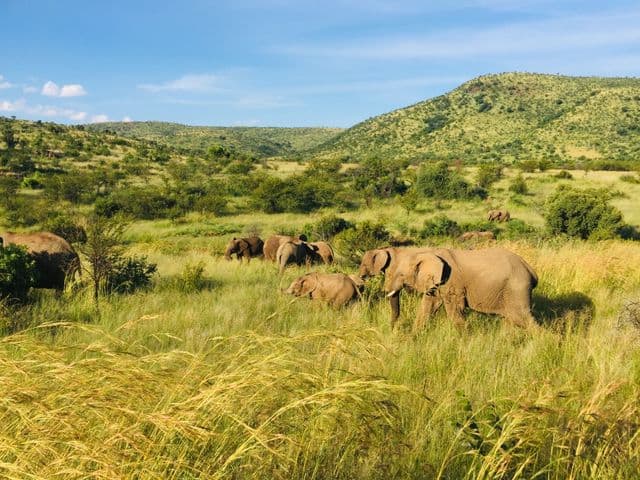
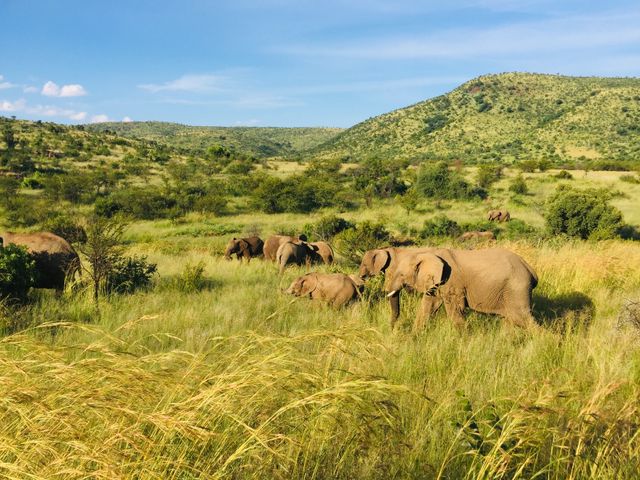
Pilanesberg's elephants are water-driven. In the dry season, a midday stop at Mankwe, Tlou or Makorwane is often more rewarding than a dawn drive, because breeding herds come down to drink and bathe in the heat of the day. Look for fresh dung and snapped branches on the gravel roads, and give herds with small calves plenty of room. See recent elephant sightings in Pilanesberg →
Lion
Lions here are often found resting on the open grassland of the central basin and the plains, or moving along roads at first and last light, when they're most active. By mid-morning they're usually flat out under a bush and very easy to drive past. A cluster of stopped cars, alarm-calling zebra or wildebeest standing still and staring in one direction are all signs worth slowing down for. See recent lion sightings in Pilanesberg →
Leopard
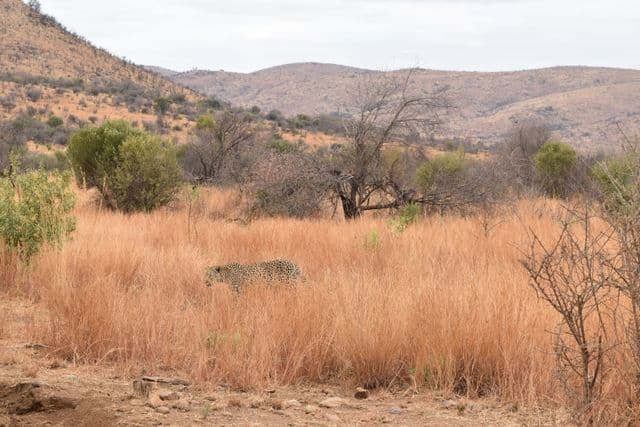
The hardest of the Big Five anywhere, and Pilanesberg is no exception. The park's rocky ridges and wooded drainage lines are classic leopard habitat. Scan the tops of rocky outcrops and the larger trees along dry riverbeds, especially early in the morning and late in the afternoon. Alarm-barking baboons and snorting impala are your best clues. For a deeper look at this, read how rangers actually spot leopards. See recent leopard sightings in Pilanesberg →
Buffalo
Buffalo favor grassland close to water and are most often seen grazing on open plains or wallowing at dam edges. Older bulls ("dagga boys") are often found alone or in small groups near water and mud. Our buffalo spotting guide covers how to read the herd.
Rhino
Pilanesberg holds both white and black rhino. White rhinos are grazers on open, short grassland and often visit the waterholes; black rhinos are browsers and keep to thicker bush, which makes them much harder to find. A note on ethics: never post a rhino's location publicly, whether it's a WhatsApp group or a geotagged photo. Poachers do watch social media. For exactly this reason, rhino can't be logged on opspoor at all.
Beyond the Big Five
Cheetah is present but rare. African wild dogs were reintroduced in 1999, but there hasn't been a confirmed sighting in years, so treat one as a once-in-a-lifetime surprise rather than something to look for. If someone at a hide does mention a pack, move fast. See our wild dog guide.
Brown hyena is the park's Kalahari signature: shy, mostly nocturnal, and a real prize if you catch one at first light.
Hippo and Nile crocodile are reliable at Mankwe Dam.
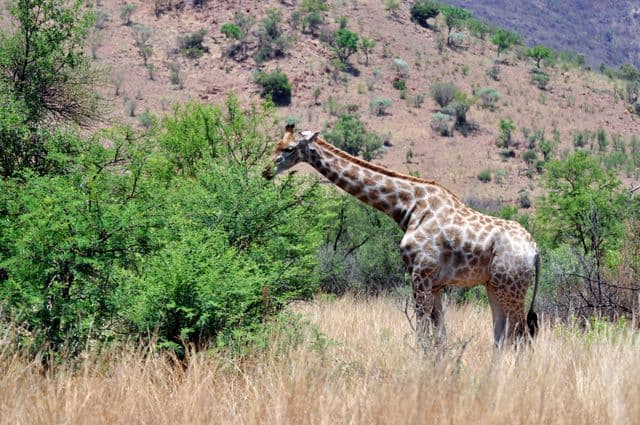
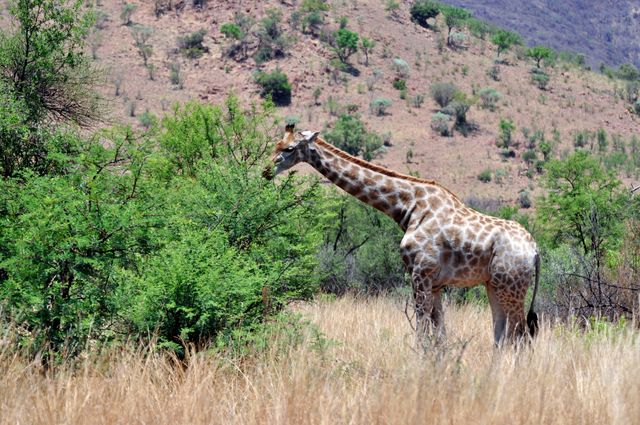
Giraffe, zebra, wildebeest, kudu, waterbuck and impala are all common, and the open plains in the central basin are the best place for them.
Sable, roan and tsessebe are uncommon but worth watching for, especially on the quieter gravel roads.
Best time of year to visit
Dry season (May to September)
This is the classic game-viewing season. The grass is short, the bush thins out, and animals concentrate around the dams, so the hides are at their best. Mornings are cold: winter dawns in Pilanesberg can be close to freezing, so bring a proper jacket and a blanket for an open car window. Days are clear and mild.
Wet season (November to March)
The park turns green and lush, and it's a beautiful time to photograph. Most antelope drop their young in early summer, so there are lambs and calves everywhere, which also means predators are active. Migrant birds arrive and the birding is at its peak. The trade-offs: thicker bush makes animals harder to see, water is spread out rather than concentrated, afternoon thunderstorms are common, and some gravel roads can close after rain. The longer gate hours help.
Weekends and school holidays
Because it's so close to Gauteng, Pilanesberg gets busy on weekends, public holidays and school holidays, especially on the tar roads and at famous sightings. A weekday visit, or getting onto the gravel loops early, makes a big difference.
Sample plans
A half-day morning
Gate opening: enter at Manyane and take the gravel loops rather than the tar straight to the centre. Drive slowly and scan the open grassland for lions that are still active.
Mid-morning: sit at Rathlogo Hide with the sun behind you.
Late morning: go up to Lenong View for the crater panorama, then down to Mankwe Dam and the Pilanesberg Centre for coffee.
A full day
Morning: the half-day plan above.
Midday: lunch at Fish Eagle Picnic Site overlooking Mankwe Dam, then a slow loop past Tlou Dam and Makorwane for elephants coming down to drink in the heat.
Afternoon: head west along Moloto Drive toward Batlhako Dam and finish at Ruighoek Dam Hide in the afternoon light.
Last hour: leave enough time to reach your exit gate before closing. Distances are short, but a single good sighting can eat 40 minutes.
opspoor Premium's Trip Itinerary builder can lay out a day like this for you on real park roads, including an automatic driving loop. Here's how it works.
Coming from Gauteng for the day? Our Pilanesberg day trip plan covers when to leave, the route and a full-day timeline.
Practical tips and park rules
Stay in your vehicle except at hides, picnic sites, the Pilanesberg Centre and other designated areas. This includes arms, heads and cameras out of windows near big animals.
Never feed animals, including the monkeys and hornbills at the picnic sites.
Respect sightings: don't block the road, don't crowd an animal's path, keep engine noise and voices down, and give other cars a turn.
Elephants have right of way. If a bull shows signs of musth or irritation (ears spread, head high, trunk swinging), back off calmly and give it space.
Fill up before you go in. Don't count on fuel inside the game-viewing area.
Bring: water, snacks, binoculars (one pair per person if you can), a bird and mammal field guide, and a warm layer for winter mornings.
Food and restrooms: the Pilanesberg Centre has a restaurant, a shop and restrooms. There are also restrooms at Mankwe, Makorwane, Rathlogo and Ruighoek hides and at Kubu Picnic Site.
Signal, sightings and opspoor
Cellphone signal in Pilanesberg is patchy. You'll often have coverage on the ridges and near the gates, but lose it in the valleys and at some of the hides. That's the reason opspoor was built offline-first.
Log a Sighting with no signal. opspoor saves the species, location, time and photos on your phone and syncs automatically once you're back in coverage.
See what others have logged. The map shows sightings logged by other visitors in the park, with a short delay on fresh sightings to prevent rushing and crowding.
Identify what you saw. The AI species ID works from a single photo, on your phone, with no connection needed.
Help confirm sightings. Other trackers confirm what's logged, so the map stays honest.
Every sighting you log helps the next visitor decide where to drive.
For every way to find out what's been seen today, from sightings apps to WhatsApp groups, and how to use a tip so you arrive while the animal is still there, see our guide to Pilanesberg sightings today.
Frequently asked questions
Can you do Pilanesberg as a day trip from Johannesburg?
Yes. It's about two hours by road from Johannesburg and Pretoria, so a day trip is very doable. Leave early enough to be at the gate when it opens, because the first two hours of the day are the most productive.
Can you see the Big Five in Pilanesberg in one day?
It's possible, and the park's small size helps, but it's never guaranteed. Elephant, rhino and buffalo are the most likely; lion takes some searching; and leopard is always luck plus patience.
Do I need a 4x4 for Pilanesberg?
No. The tar roads and most main gravel roads are fine in an ordinary sedan in dry weather. After heavy rain, check which roads are open and avoid the minor dirt tracks.
Is Pilanesberg malaria-free?
Yes. Pilanesberg is in a malaria-free area, which is one of the main reasons it's popular with families.
What's the speed limit in Pilanesberg?
40 km/h on all park roads. Driving slower than that on the gravel roads will get you more sightings.
Can I get out of my car in Pilanesberg?
Only in designated areas: the hides, picnic sites, the Pilanesberg Centre and lodge or resort grounds. Everywhere else, stay inside your vehicle.
Is Pilanesberg a SANParks park?
No. Pilanesberg is managed by the North West Parks Board, so SANParks Wild Cards and SANParks bookings don't cover it.
Before you go
Pilanesberg rewards visitors who slow down, get off the tar, and give the waterholes time. Do those three things and it stops being "the park near Sun City" and becomes one of the best Big Five experiences in the country.
Download opspoor before you leave home so the park is already on your phone, check the Pilanesberg park page for recent activity, and Log a Sighting whenever you find something worth sharing, signal or not.
Gallery