
How to Spot a Leopard on Safari (Kruger Tips)
Look up, not ahead: leopards rest in big trees along rivers. Drive at 15 to 25 km/h, follow impala and baboon alarm calls, and time your drive for dawn.

Of the Big Five, the leopard is the one most visitors leave without. Leopards are solitary, mostly active at night, and wear a coat designed to disappear into dappled shade. Many people drive past one without ever knowing it was there.
But leopards aren't invisible. They follow habits, they leave signs, and the rest of the bush reacts when one moves. This guide covers how leopards live, where they spend the day, the alarm calls and tracks that give them away, how to scan for them, where to look in Kruger and Pilanesberg, and how to behave at a sighting once you've found one.
Why leopards are so hard to find
They live alone. Apart from mothers with cubs and brief pairings to mate, leopards are solitary. There's no herd or pride to spot from a distance, just one cat.
They're territorial. Each leopard holds a home range it knows intimately. A male's territory typically overlaps those of several females. That's good news: a leopard seen in an area is likely to be seen there again.
They're mostly nocturnal. Leopards hunt mainly at night and around dawn and dusk, and spend the heat of the day resting out of sight.
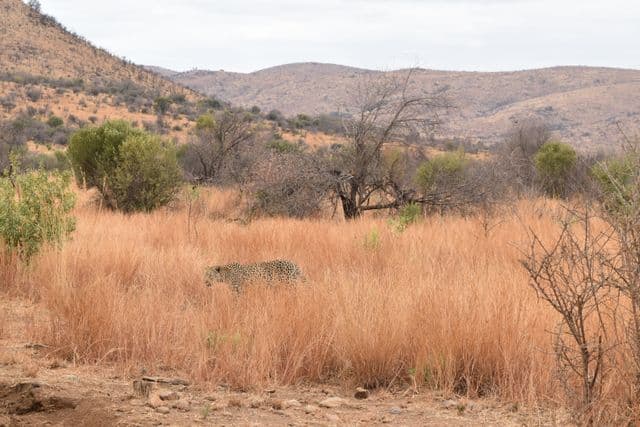
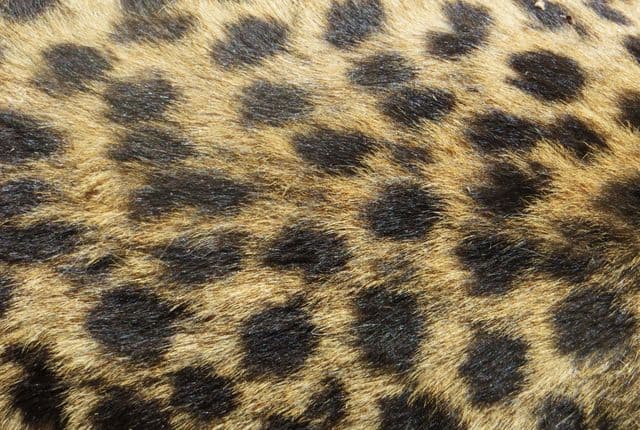
They're built to hide. The rosette pattern breaks up the leopard's outline in grass, leaves and shadow. A resting leopard 30 meters away can look exactly like a branch.
They're smaller than people expect. Males can weigh 60 kg or more and females are much smaller, often around half that. That's a lot less cat to see than a lion.
Look up, not just ahead

Leopards are the only big cats in Africa that routinely haul their kills into trees, out of reach of lions and hyenas. They're strong enough to carry a carcass heavier than themselves up a trunk. A hanging impala, or a tail dangling below the canopy, is one of the strongest signs you'll ever get.
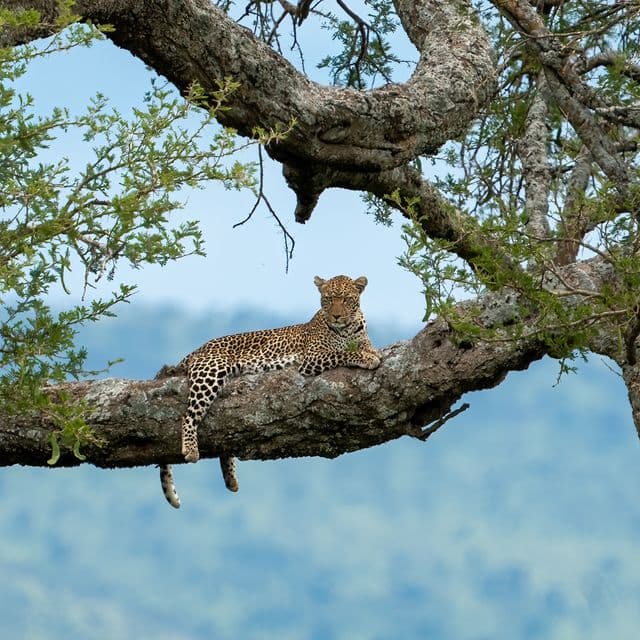
They also rest in trees, draped along a thick horizontal branch in the shade. The trees they favor share a few features: big, sturdy, with wide horizontal limbs and good shade, usually along a river or drainage line. In the Lowveld, look at marula, sausage trees, jackalberries, leadwoods and large knob thorns. When you pass a tree like that, slow down and check every thick branch, not just the ground beneath it.
Where leopards spend the day
Leopards need two things: cover to rest and ambush from, and prey nearby. That puts them in predictable habitats:
Riverine bush: the dense strip of tall trees and thickets along rivers holds more leopards than almost anywhere else, along with plenty of impala and bushbuck.
Dry riverbeds and drainage lines: sandy beds with thick vegetation along the banks are natural travel routes and resting spots. Scan both banks.
Rocky outcrops (koppies): boulders give leopards shade, height and a hidden place to watch from. Scan the tops and the shadowed gaps between the rocks.
Culverts and road edges: leopards use roads to move at night, and sometimes rest in shaded culverts under them during the day.
Follow the alarm calls
The bush has its own early-warning system, and it's the best leopard-finding tool you have. When a predator moves, prey animals tell everyone:
Impala give a sharp, explosive snort and stare fixedly in one direction.
Baboons give a loud, repeated two-note bark, often from high in the trees or on rocks.
Vervet monkeys chatter and call repeatedly, and all look toward the same spot.
Kudu give a deep, gruff bark.
Tree squirrels, francolins and guineafowl make a persistent, agitated racket.
When you hear alarm calls, stop, switch off the radio and look where the animals are looking. A group of impala all staring at the same thicket is pointing at something. Give it a few minutes; leopards often move on and the calls move with them.
Time your drive around dawn and dusk
Your best odds are in the first two hours after the gates open and the last two hours before they close. At dawn, leopards are often still moving after a night of hunting, crossing roads or walking along drainage lines toward a resting spot. In late afternoon, they wake up, stretch, and start moving again.
Midday isn't hopeless: that's when you find leopards resting in trees, if you scan carefully. In the cooler winter months, they may also lie in the open on rocks or termite mounds to warm up in the morning sun.
If you want to see a leopard at its most active, book a guided sunset or night drive. In Kruger these run from the rest camps with SANParks guides and a spotlight, and they're one of the best leopard opportunities available, because you're out during the hours when leopards actually hunt.
Know the tracks

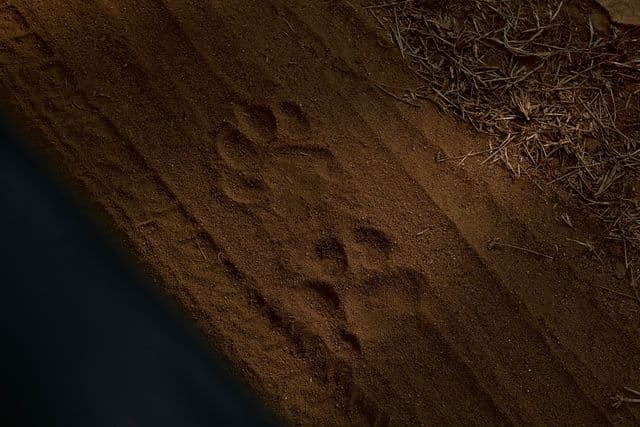
A leopard's paw print is distinctive: generally round in shape, with four toes and a broad heel pad. One of the easiest ways to tell a leopard track from that of a dog is the absence of claw marks. Like a housecat, a leopard has retractable claws, so they're usually tucked away while the animal is walking. A dog, jackal or hyena track shows claw marks and is longer than it is wide.
The difference from a housecat is, of course, one of scale: a leopard's print is essentially a much larger version of the familiar tracks left by a domestic cat. A lion's print looks similar but is much bigger, so size is the main clue between the two.
Finding fresh tracks can be an exciting clue that a leopard has passed through an area. Soft sand along a quiet road preserves footprints particularly well, and tracks spotted at first light may mean that a leopard moved through during the night. Look for a clear, well-defined print and compare several tracks rather than relying on a single footprint. Sharp edges mean fresh; tracks blurred by wind or crossed by other animals are older. The direction and spacing of the prints can also tell you where the animal was heading and whether it was walking or moving fast.
Other signs to watch for
Drag marks: a wide, smooth trail through sand or grass where a leopard has dragged a kill toward a tree or thicket.
A kill with no vultures: leopards hide kills in trees and dense cover, so vultures often don't find them. A carcass in a tree is a leopard kill almost every time.
Scrapes and scent marking: leopards mark their territories by spraying scent on bushes and scraping the ground with their hind feet.
The call: a leopard's territorial call sounds like a saw cutting wood, a rasping series of grunts. You're most likely to hear it at night from camp.
Stopped cars: a car parked with everyone staring into a tree is worth slowing down for.
How to scan for a leopard
Finding a leopard is mostly about scanning technique. A few habits make a big difference:
Drive slowly. 15 to 25 km/h on promising roads. Faster than that and your eyes can't pick out a still animal against busy bush.
Scan in layers. Check the road edge, then the middle distance, then the tree line and branches. Repeat.
Look for shapes, not spots. At distance you won't see rosettes. Look for a horizontal shape along a branch, a round head, a hanging tail, or an ear flicking.
Use binoculars. Check every suspicious shape. Most will be branches. One won't be.
Split the job. The driver watches the road; everyone else takes a side of the car and a height to scan.
Where to look in Kruger
Southern Kruger has a strong reputation for leopards, thanks to dense riverine bush and plenty of prey. The road along the Sabie River between Skukuza and Lower Sabie is one of the best-known leopard routes in Africa, and the roads around Skukuza and along the Sand River are consistently good. The granite koppies of the southwest, around Pretoriuskop and Berg-en-Dal, also hold leopards among the rocks.
Further north, leopards are present throughout, but thicker mopane and lower visitor numbers mean fewer reported sightings. Rivers and their drainage lines remain your best bet everywhere in the park. Check recent leopard sightings in Kruger before you choose a route.
Leopards in Pilanesberg
Pilanesberg's rocky volcanic ridges and wooded valleys are ideal leopard habitat. Scan the rocky outcrops on the ring hills and the larger trees along drainage lines, especially early and late in the day. Our Pilanesberg self-drive guide covers the roads and hides in detail, and one opspoor user recently captured a leopard hunting impala in Pilanesberg. See the latest leopard sightings in Pilanesberg.
Best time of year
The dry winter months (May to September) are easiest. Grass is short, leaves have fallen, and you can see much further into the bush and up into the trees. Prey concentrates near water, and leopards follow.
In summer (November to March), the bush is thick and green, and leopards are harder to see. The upside: impala lambs are born in early summer, and leopards take full advantage, so hunting activity is high.
At the sighting: leopard etiquette
Stay on the road. Driving off-road is not allowed in Kruger or Pilanesberg, however close the leopard is.
Keep quiet and still. Talk softly, avoid sudden movements and don't bang doors or call out to the cat.
Don't block its path. If the leopard is moving toward the road, give it space to cross. Don't chase it along the road.
Share the sighting. Take your time, then move on so other cars can get a view.
Watch the leopard, not just the camera. Many of the best moments happen after the first photos, when the cat relaxes and starts to behave naturally.
Log what you see with opspoor
Because leopards are territorial, a sighting in one spot is useful for days. Every leopard sighting logged in opspoor helps other visitors know where the cats have actually been active, even with zero signal in the park: your sighting is saved on your phone and syncs when you're back in range. To keep sightings from turning into a rush, opspoor shows new sightings on the map after a short delay.
Frequently asked questions
Where is the best place to see leopards in Kruger?
The south, especially along the Sabie River between Skukuza and Lower Sabie, and around the Sand River. Any river with dense riverine bush is worth driving slowly.
What time of day are leopards most active?
At night and around dawn and dusk. Early morning and late afternoon drives give you the best chance of seeing one moving. Guided night drives are even better.
How do you tell a leopard track from a hyena track?
Leopard tracks are round, with no claw marks, because the claws are retracted. Hyena tracks are longer, show claw marks, and have a differently shaped heel pad.
Why do leopards put their kills in trees?
To protect them from lions and hyenas, which will steal a leopard's kill if they find it on the ground.
Can you see leopards in Pilanesberg?
Yes. Pilanesberg's rocky hills and wooded valleys hold leopards, although like everywhere they take patience to find.
Is it worth doing a night drive for leopards?
Yes. Leopards are most active after dark, and a guided night drive is often the single best chance of seeing one on a self-drive trip.
Before you go
Look up into the trees, listen for the alarm calls, read the sand, drive slowly and spend your time at dawn and dusk. None of it guarantees a leopard, but together it moves the odds a long way in your favor.
Download opspoor before your trip, check recent sightings in camp, and Log a Sighting when you find one, so the next visitor has a better chance too.
Gallery