How to Spot African Wild Dogs on Safari (Kruger Tips)
African wild dogs are one of the rarest sightings on safari. How to recognize them, how packs hunt, why the winter denning season is your best chance, the signs a pack is near, and where to look in Kruger.

African wild dogs are one of the rarest sightings on a South African safari, and for many experienced safari-goers, the most exciting. A pack can cover tens of kilometers in a day, turn up on a road you drove an hour ago, and be gone again before most visitors hear about it. There's no reliable spot to wait for them, so finding wild dogs is about knowing how packs behave and acting quickly on fresh information.
This guide covers how to recognize wild dogs, how packs live and hunt, the denning season when they're easiest to find, the signs that a pack is nearby, where to look in Kruger, what we know about Pilanesberg's dogs, and how to behave at a sighting of one of Africa's most endangered carnivores.
Why wild dogs are special
The African wild dog (Lycaon pictus, also called the painted wolf or painted dog) is listed as Endangered by the IUCN. Fewer than 7,000 are thought to remain in the wild, split across fragmented populations in eastern and southern Africa. They've disappeared from most of their former range because they need huge areas to roam, and they're vulnerable to snares, road accidents, conflict with farmers and diseases like rabies and canine distemper caught from domestic dogs.
Kruger holds South Africa's largest wild dog population, a few hundred animals. Most of the country's other packs live in smaller fenced reserves and are managed together as one population, with dogs moved between reserves to keep the gene pool healthy. Every sighting is genuinely special.
They're identifiable at a glance

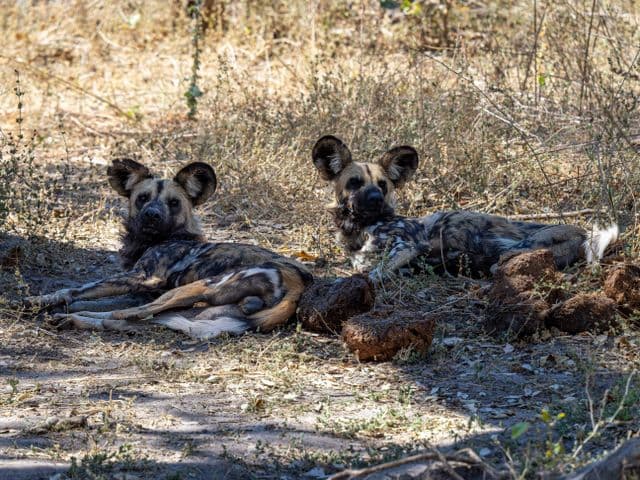
Wild dogs have a blotched, irregular coat pattern of black, brown, white and tan. No two dogs are patterned the same way, so researchers can identify individuals from photographs, much like a fingerprint. Their large, rounded "Mickey Mouse" ears and bushy white-tipped tail make them easy to tell apart from hyenas at a distance, even in poor light.
A few quick comparisons help:
Spotted hyena: much bulkier, with a sloping back, a heavy head, round ears and a short, dark tail. Hyenas are often alone or in twos and threes; wild dogs are almost always in a group.
Black-backed jackal: much smaller, with a neat silver-black "saddle" and pointed ears.
Wild dog: lean, long-legged, about the size of a medium domestic dog (roughly 20 to 30 kg), patchy coat, big round ears, white tail tip.
Look for the pack, not a lone animal

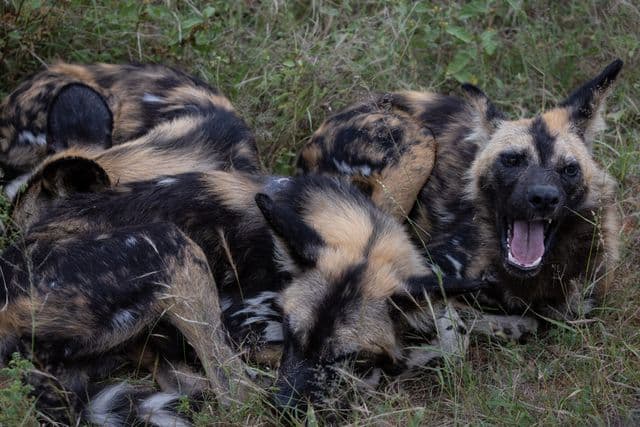
Wild dogs are among the most social carnivores on earth. A pack usually numbers from about 5 to 20 or more animals, and they're rarely seen alone. Normally only the dominant male and female breed; the rest of the pack helps raise their pups, hunting for them and bringing back food.
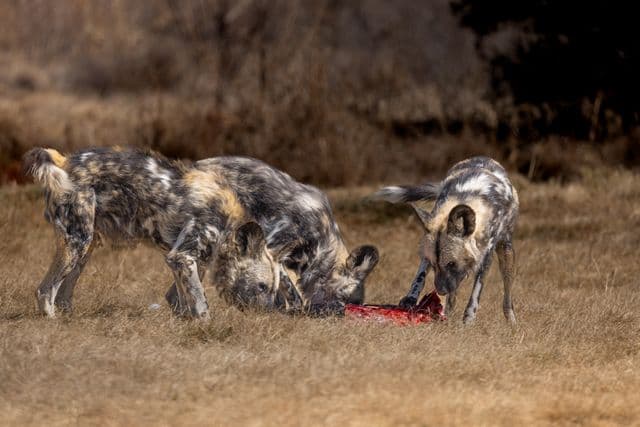
Their social life is one of the joys of a sighting. Before a hunt, the pack performs a noisy greeting ceremony: running, twittering, licking and nuzzling each other's faces, working itself up. After a kill, wild dogs share food with the pups, the sick and the injured, regurgitating meat for pack members who weren't at the hunt. Watch for these interactions rather than just counting dogs.
A pack on the move covers ground quickly and can travel long distances in a single day, which is why sightings tend to be reported and then gone within hours. Fresh, specific information matters more for wild dogs than for almost any other species.
Dawn is prime time
Wild dogs hunt mainly in the early morning and late afternoon, when it's cool enough for long chases. The first hour or two after sunrise is the best window of the day: the pack is often active, playing, greeting and setting off to hunt. By mid-morning, a pack that has fed will usually flop down in the shade and sleep through the heat, often in a tight heap of dogs under a bush close to the road.
Resting packs are easy to miss. If you drive past a shaded thicket and see what looks like a pile of mottled logs, look again through binoculars.
Watch for a hunt in progress

Wild dogs are coordinated pack hunters that chase prey over long distances rather than ambushing it. They can run at up to around 60 km/h, and their stamina, not their top speed, is what wins. Their hunting success rate is among the highest of any large African predator. In Kruger, impala are their main prey, along with young kudu and other antelope.
The signs of a hunt are dramatic: impala scattering at full speed across open ground, snorting alarm calls, and a sustained commotion that moves quickly through the bush. Baboons and impala alarm calls are, again, one of the best early warnings. If you see antelope running flat out and something is chasing them, stop and watch the direction they came from.
Wild dogs kill and eat very quickly, partly because hyenas and lions will steal their food. A kill can be almost finished within minutes, so if you find a pack on a carcass, stay put: you're in for a remarkable, if intense, few minutes.
The denning season: your best chance
For most of the year, packs are nomadic. That changes in the denning season, roughly May to August in South Africa. The dominant female gives birth in an underground den, often an old aardvark burrow, and the pack stays close to it for about three months while the pups are small. Litters are large, commonly around ten pups.
During those months, a pack is far more predictable, returning to the den every day. That makes winter the best time of year to see wild dogs, and it's also why rangers and park management protect active dens carefully. In Kruger, roads near a known den are sometimes closed to protect the pups.
If you find a den, or hear about one, treat it with care:
Keep your visit short, quiet and at a distance, and follow any road closures.
Don't post the location of a den publicly. Disturbance can make a pack abandon a den, and the pups inside it.
Never try to attract the dogs' attention.
Once the pups are around three months old, the pack leaves the den and returns to its wandering life, with the pups trailing behind.
Signs that a pack is nearby
Tracks: wild dog prints are unusual among dogs because they have only four toes on every foot, including the front feet. Claw marks show clearly. Many tracks overlapping on the road, all heading the same way, point to a pack on the move.
Roads: packs often use roads to travel, especially sandy roads in the early morning. Fresh tracks on a road at dawn are worth following slowly in the direction they're heading.
Calls: wild dogs keep in touch with a soft, bell-like "hoo" contact call, carried a surprisingly long way, and twitter excitedly when they greet each other.
Scattering prey: herds of impala suddenly running, or alert and bunched up, can mean dogs are hunting nearby.
Other people: a car heading toward you slowly with its occupants staring into the bush behind them is worth asking about.
Where to look in Kruger
Wild dogs range across the whole of Kruger, but they're most often reported in the south and southwest, in the mixed woodland between Skukuza, Pretoriuskop, Lower Sabie and Crocodile Bridge. Open areas and sandy roads in these regions are good places to look at first light. Because packs move so widely, the best "where" is always the most recent sighting. Check recent wild dog sightings in Kruger before you plan your route, and ask at the camp sighting boards.
Wild dogs in Pilanesberg
Wild dogs were reintroduced to Pilanesberg in 1999, but there hasn't been a confirmed public sighting in years, and the park hasn't published a recent count, so we can't say whether a pack is still there. If wild dogs are the goal, go to Kruger. If you're in Pilanesberg anyway and someone does report a pack, move quickly and log it. Our Pilanesberg self-drive guide covers the roads and hides, and the Pilanesberg park page shows recent activity.
Best time of year
The dry winter months (May to August) are the best time for wild dogs: denning packs are tied to one area, the bush is open, and cool mornings mean long periods of activity. In summer, packs roam widely, the bush is thick, and sightings are more a matter of luck, although well-grown pups traveling with the pack can make for great viewing.
At the sighting
Stay on the road and stay in your vehicle. Never drive off-road to follow a pack.
Don't chase them. Packs on the move often run along the road. Let them go, or follow slowly at a distance without pushing them.
Keep quiet. Wild dogs are curious and sometimes come close to cars; stay still and let them.
Watch for hyenas. Hyenas often shadow packs to steal kills, and the standoffs can be spectacular.
Give way to other cars once you've had a good view. Everyone deserves a turn at a sighting this rare.
Log your sighting with opspoor
Because packs move so fast and so far, a fresh sighting logged in opspoor is often the only real way to know where wild dogs are right now. Your sighting saves on your phone with no signal and syncs automatically when you're back in range. Logging the direction the pack was traveling makes your sighting far more useful to the next person. Check recent species sightings to see where packs have been active lately.
Frequently asked questions
Where can I see wild dogs in South Africa?
Kruger National Park has the country's largest population, and the south and southwest produce the most sightings. Packs also live in several smaller fenced reserves. Pilanesberg had wild dogs after a 1999 reintroduction, but there hasn't been a confirmed sighting there in years.
When is the best time to see wild dogs?
Early morning, and during the denning season from about May to August, when packs return to the same den every day.
How rare are African wild dogs?
Very. They're listed as Endangered, with fewer than 7,000 thought to remain in the wild across Africa.
Are wild dogs dangerous to people?
Wild dogs have no history of hunting people, but they are wild predators. Stay inside your vehicle and keep your distance like you would with any other large carnivore.
How can I tell a wild dog from a hyena?
Wild dogs are leaner, with long legs, a patchy black, tan and white coat, big round ears and a white-tipped tail. Hyenas are bulkier, with a sloping back, a heavy head and a short tail.
Why are they called painted wolves?
Because of their blotched, multicolored coats. The scientific name Lycaon pictus means "painted wolf-like animal."
Before you go
Get out at first light, watch the sandy roads for tracks, listen for alarm calls, and act fast on recent sightings. Visit in winter if you can, and treat any den with extra care.
Download opspoor before your trip, and if you're lucky enough to find a pack, Log a Sighting with its direction of travel. For a species this rare and this mobile, your sighting could make someone's whole trip.
Gallery