

Cheetahs in Kruger: Where and When to See Them
The cheetah (Acinonyx jubatus) is the fastest land animal alive, capable of speeds up to 110 km/h over short bursts. But for all that speed, it's also one of the rarest and most fragile big cats in Kruger National Park — here's what you need to know to spot one.
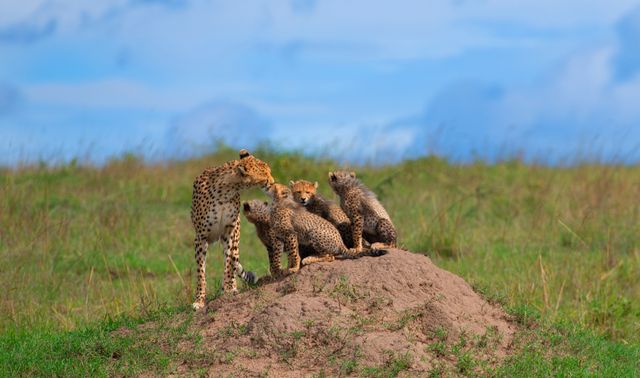
Cheetah vs. leopard - don't mix them up
Spots: Cheetahs have small, solid black spots; leopards have rosettes (ring-shaped spot clusters).
Face: Cheetahs have distinctive black "tear" streaks running from the eyes to the mouth — leopards don't.
Build: Cheetahs are slender, long-legged and lightly built for speed; leopards are heavier and more muscular for climbing and dragging prey.
Behaviour: Cheetahs hunt by day in open grassland; leopards hunt at night and haul prey up into trees.
Built for speed: a cheetah's physical adaptations
A cheetah's entire body is engineered around one thing — acceleration. An enlarged heart, lungs and nasal passages let it take in far more oxygen during a chase than its body size would suggest. Semi-retractable claws work almost like running spikes, biting into the ground for grip instead of staying sheathed like a leopard's. A long, flattened tail acts as a rudder, letting the cat make sharp, high-speed turns without losing balance — essential when prey jinks unpredictably. A flexible spine extends its stride length with every bound, and it can go from a standstill to around 100 km/h in roughly three seconds. The trade-off for all this specialisation is fragility: cheetahs are lightly built and can't out-muscle a lion, leopard, or hyena in a direct confrontation.
Cheetah habitat
Cheetahs favour open grassland and savanna where they can put their speed to use — unlike leopards, which prefer dense bushveld. In Kruger, they're most often seen on the central plains, especially around Satara and Tshokwane, where open terrain gives excellent visibility.
When are cheetahs active?
Unlike most big cats, cheetahs hunt during the day — typically early morning or late afternoon when it's cooler. They largely avoid the night because they can't defend themselves as well against lions and hyenas. That makes them one of the few big cats you can genuinely expect to encounter on a morning game drive.
How does a cheetah hunt?
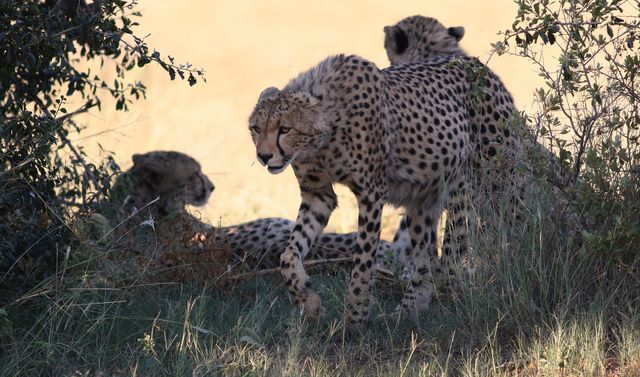
A cheetah's hunt begins long before the chase — it typically scans from a raised vantage point and singles out an isolated or distracted target, usually impala, springbok, duiker, or young wildebeest calves. The chase itself rarely lasts longer than 20 to 30 seconds; the cheetah's body can't sustain the heat and physical strain of that speed for much longer. If the chase fails, it needs 20 to 30 minutes to recover before trying again. This is also why cheetahs are so vulnerable to other predators — an exhausted cheetah can easily lose its kill to lions, hyenas, or even a determined group of vultures.
Cubs: the most vulnerable stage of a cheetah's life
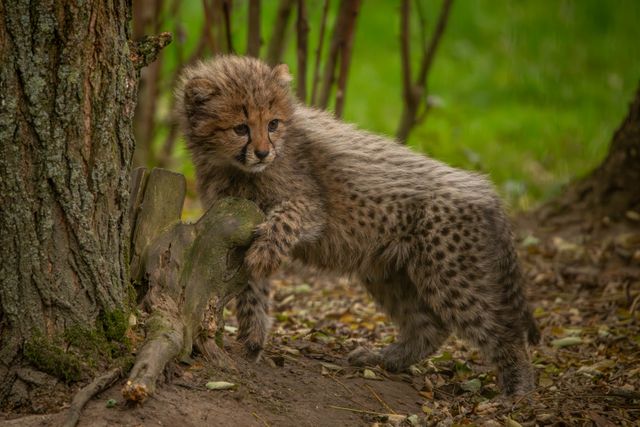
Cheetah cubs are born blind and helpless, in litters of two to six, hidden in dense grass or thick bush rather than a den burrow — the mother moves them to a new hiding spot every few days to throw off predators that might have picked up their scent. For the first roughly eight weeks, cubs carry a smoky-grey mane of long fur running down their back and neck, called a mantle. It's thought to help camouflage them in grass and, from a distance, to make them resemble the far more aggressive honey badger — a possible deterrent to predators that would otherwise treat them as easy prey.
Cub mortality is brutal: in areas with high densities of lions and hyenas, as few as 5–10% of cheetah cubs survive to independence, making cheetahs one of the most reproductively vulnerable big cats in Africa. A mother hunts alone and must leave her cubs hidden and undefended every time she does, which is when most losses happen. Around three months old, cubs start following her on hunts to learn technique, and she'll often release a still-living captured animal for them to practise the chase and kill themselves. Cubs stay with their mother for around 18 months before becoming independent, and it's not until they've split from their littermates — usually around two years old — that females go on to breed and males settle into a territory or coalition.
Coalitions: brothers for life
Female cheetahs are largely solitary once cubs are weaned. Males, however, often go the opposite route: brothers from the same litter frequently stay together for life as a coalition of two or three, hunting cooperatively and jointly defending a territory. A coalition is significantly more successful at hunting and, crucially, at defending a kill from scavengers than a lone male — which is also why, if you do spot cheetahs in Kruger, there's a decent chance you'll find more than one together.
Conservation status: why every sighting matters
Cheetahs are classified by the IUCN as vulnerable, with fewer than 7,000 individuals estimated to remain worldwide. Kruger's population is one of the most important remaining free-roaming groups, but it stays under pressure from competition with lions and leopards for prey and territory, high cub mortality, and habitat loss outside protected areas. Because cheetahs range over huge areas — a male coalition's home range can span hundreds of square kilometres — consistent, location-specific sighting data is one of the best ways to understand how they use the park over time.
What to look out for
Cheetahs often hunt in small groups (brother coalitions) or as a mother with cubs, and they frequently perch on termite mounds or other raised points to scan the plains. A sudden scatter of impala across open ground, or vultures beginning to circle, can be a sign a chase has just taken place nearby.
Best places to spot cheetahs in Kruger
Satara area: the open grassland around Satara is widely regarded as the best cheetah territory in the entire park.
Tshokwane: open terrain with good visibility, near the S36 and S100.
S100 gravel road: one of the park's best-known cheetah hotspots, especially early morning.
Nsemani Dam area: open plains that regularly draw prey animals, and cheetahs with them.
Keep in mind that cheetah movement shifts from season to season and year to year as prey availability changes — which is why recent, up-to-date sightings are worth far more than general "best spots" folklore.
Frequently asked questions
How many cheetahs are there in Kruger National Park?
Estimates vary, but Kruger's cheetah population is generally put at somewhere between 150 and 300 individuals — one of the largest free-roaming populations remaining in South Africa.
Are cheetahs dangerous to humans?
No. Cheetahs are shy and largely avoid people; there's no reliable record of a wild cheetah attacking a person in Kruger. Still, always stay inside your vehicle, as with all Kruger wildlife.
What's the best time of day to see cheetahs?
Early morning (shortly after gate opening) and late afternoon, when it's cooler and cheetahs are most active.
How long do cheetah cubs stay with their mother?
Around 18 months. After that they become independent, and male littermates will often stay together afterwards as a lifelong coalition.
Log your sighting with opspoor
Cheetahs are rare enough that every sighting genuinely matters. Log it in opspoor to help other visitors know where they've been active recently — or browse recent species sightings to see where.
Gallery


More from the blog


opspoor tracks real, verified wildlife sightings across South Africa's parks — logged by people on the ground, not guesswork.